

Windows provide illumination, clear views and a consistent flow of light and air. Bringing enough sunlight into your home may seem complex – especially considering aspects like glare and solar heat gain.
Daylighting allows you to enhance your home’s light and thermal efficiency with the power of natural light. Windows play an important role in this concept.
Daylighting is the controlled use of natural light to provide optimal illumination indoors. It involves careful placement of windows and reflective surfaces. A well-designed daylighting system may involve only windows and skylights or incorporate a daylight-responsive lighting control system for lighting that works only when needed.
To use daylight effectively, you must consider several unique aspects integral to how natural light works. These include:
Incorporating natural light into your home offers some significant benefits, including the following:
Maximizing access to natural light offers significant health benefits. These include better sleep patterns, better Vitamin D absorption and enhanced cognitive function.
Studies have shown that exposure to natural light boosts productivity. Maximizing your home’s daylighting can make your family feel livelier and accomplish more. Whether you work from home or have children in school, this is a significant benefit. Schools have also reported boosted productivity in sunlight-rich environments.
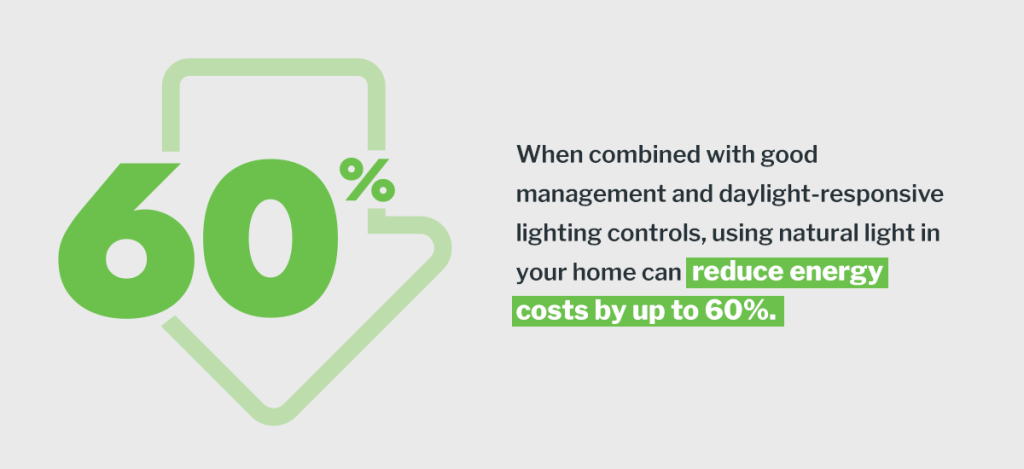
In 2020, lighting caused nearly 75% of U.S. energy consumption. When combined with good management and daylight-responsive lighting controls, using natural light in your home can reduce energy costs by up to 60%.
Here are a few expert tips explaining how to maximize your home’s daylighting.
Window choices are one of the most essential aspects of daylighting. A good, energy-efficient window allows plenty of sunlight without allowing excessive heat entry. Limit glaring and discomfort by choosing an insulated, glazed or treated solution.
For the best solution, choose an appropriate window design, like:
Consider the strip window if you want the best, most consistent daylighting for your home. This window design consists of a continuous strip of windows spanning the building exterior. It’s an excellent way to offer uniform light distribution, but it may offer less light access than a vertical window.
Punched windows are a popular alternative that generally allows sufficient light penetration. However, the extended breaks between windows often produce a high-contrast effect, exaggerating glare and dark areas. You can counteract this by pairing these windows with work areas or glare prevention measures.
Arrangement is the companion to window selection and placement. While you can only achieve so much natural light infiltration, you can rearrange furniture and appliances to make the most of available light. Try not to place large, opaque objects in front of windows and, when possible, opt for an open-plan space that minimizes light interruptions.
While you can’t control how much light you get, you can control what you do. Here are a few ways to maximize daylight distribution:
When choosing your new window, consider the size and glazing simultaneously, including the following concepts:
One of the main obstacles to efficient daylighting is getting sufficient light deep into the space without creating glare. Tall windows like bay windows often offer better penetration, since the daylighted area is generally between one-and-a-half and two times the window’s height.
For example, the average window height is between nine and 10 feet, so you can expect a maximum daylight zone of 20 feet from the window. You may extend this coverage further by adding a reflective light shelf, which reflects light from one room into another.
While installing large windows near high-activity areas may seem logical, it can make these areas too warm for comfortable occupation. Instead, opt for smaller, vertical windows partnered with reflective surfaces and optimal object placement.
Large windows generally require more management. If you install large windows, glazing controls glare and reduces heat gain. Consider an energy-efficient window with a low-emissivity (low-E) coating to regulate heat loss in winter and improve comfort.
Many attempts to harvest sunlight focus on a single direction, leading to glare and hot spots. Harvest light from windows on multiple sides of the building to avoid this.
North-facing windows provide consistent daylight and minimal heat gains. South-facing windows impart stronger illumination and offer easy shading. Shading is more difficult with east- and west-facing windows.
Our unique designs and product selection make the most of daylighting using windows, offering benefits like:
Our advanced glass solutions admit considerable daylight while minimizing thermal transfer. The multilayered design has more layers than standard low-E coated glass, maximizing the results. Our High-Performance™ Low-E4® glass allows 72 percent of visible light while blocking up to 58 percent of undesirable solar heat and 84 percent of damaging ultraviolet rays.
Our diverse configurations and custom units can open up your space to provide a dramatic sense of light and airiness. Access to many shapes and styles allows you to be as creative as you like while boosting your home’s daylighting.
Thanks to our patented Fibrex® material, Renewal by Andersen® windows have narrower frames. This strong material offers sufficient support with a relatively narrow frame. The result? A narrow-framed, large-paned window that admits more light.
Maximize your use of natural light with beautiful, energy-efficient windows and doors. Whether you prefer traditional double-hung or casement windows, custom-fit windows or sliding patio doors, we can help. Our industry-leading products and outstanding customer service ensure consistent customer satisfaction.
Make your home a brighter, more energy-efficient space today. Call us or fill out our contact form for a free, in-home consultation.