
Inspecting your home’s exterior after an extreme weather event helps you find and minimize damage quickly. We recommend starting with your windows, as wind-driven debris can easily damage their glass panes.
At Renewal by Andersen, our window replacement experts have a quick guide to help you inspect your windows safely, find any exterior or interior window storm damage, and resolve the problem efficiently.
When checking a window for storm damage, there are a few things you can do to keep the process safe and effective. These include the following:
Before going outside to inspect your home’s exterior, ensure there are no immediate safety risks. Look for downed power lines, fallen trees, and other potentially dangerous storm consequences. Safety should always be your priority, so protect yourself during the storm as well.
When checking your windows for signs of storm damage, look for the following:
Any one of these may indicate a damaged window or window seal. If you see a sign of damage, it’s best to contact a professional.
Pro tip: If you suspect a storm damaged the window seal, shut the windows and doors and light an incense stick near your windows. If there is a leak, the incense smoke should drift toward it.
When checking the windows for storm damage, wipe away any exterior condensation so you can see any interior moisture. Condensation forming in the space between glass panes is a sign that your window’s seal has failed.
Manufacturers fill insulated windows with either Argon or Krypton, two nontoxic gases that prevent heat transfer. Damaged window seals allow Argon and Krypton to escape. Moisture can then infiltrate the space between window panes, fogging your windows.
Most storm damage to a window fits one of a few types. When inspecting your windows, you should look for the following:
Storms may be accompanied by hail, which is notorious for causing impact damage. After a hailstorm, look for these types of damage:
Strong winds place immense pressure on windows, especially larger bow and bay window panels. After a windstorm, look for:
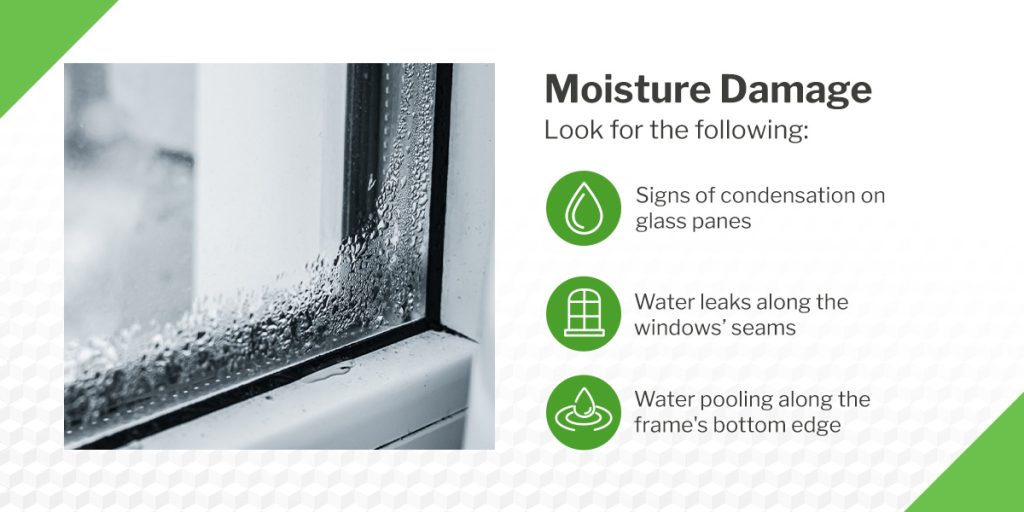
Moisture damage happens more slowly than other types of window damage, but generally causes longer-term problems. Look for the following:
Any of these kinds of water damage may cause rust or rot to form.
Broken glass should be one of the first things you clean up after a violent storm. Here’s a step-by-step guide to managing broken windows after a storm.
Before cleaning up the broken glass, record the damage using a video recording or photos. Take pictures of where the glass came from and where it ended up. You may need this for your homeowners insurance claim.
When glass shatters, it has a lot of energy behind it, so it travels farther than you’d think. If you can sweep the area, enter the room with shoes and protective gloves, then sweep any glass on surfaces down to the floor.
Next, sweep the entire floor for glass. Although the glass may look concentrated in one area, small pieces often travel farther.
In a carpeted area, use a shop vacuum to remove all the glass in the room.
To prevent further damage to your home, cover the holes in the broken window. Tarps work as a quick, temporary solution, but screwing in pieces of wood is a more secure choice.
Note: This is a temporary solution intended to prevent people, bugs and weather from entering your home until you can get the windows replaced.
File a claim with your insurance company as soon as you can. It’s generally better to work through your agent. However, after a storm, many houses in your area may have suffered damage, and your insurance agent will be swamped with calls.
Replacing storm-damaged windows is more cost-effective in the long term. However, repair is a viable option if the damage is mainly cosmetic, such as chipped paint without damage to seals or panes.
With more significant damage, repairs can’t refill the Argon and Krypton gas to restore the window’s energy efficiency. They can only fix the window seal to prevent the remaining gas from leaking out.
Call a professional if you’re unsure whether a window needs repair or replacement. They’ll assess the window expertly and tell you how severe the damage is.
Hire a Professional to Replace Glass Panes
Certain window problems are difficult or impossible to detect to the untrained eye. This is why, even after performing your own inspections, it’s wise to call a certified window inspector.
An expert will spot any problems with your casement, fixed or sliding window. Get your windows checked by a certified expert ASAP. As a leading window company, Renewal by Andersen can inspect and replace windows with storm damage.
Contact us today to schedule a free consultation with one of our design experts. The team at Renewal by Andersen would love to help you find the ideal replacement window or door.