

Ventilation can dilute pollutants and improve indoor air quality in your home. It can also help with passive cooling to reduce HVAC expenses during the warmer months. And natural ventilation starts with your windows. Some window styles perform better than others, and you might need replacement windows to get optimal ventilation in your home.
Proper ventilation supports a healthier home, protects your investment and can help reduce energy costs. By choosing the right window styles, you create pathways for air to circulate naturally, carrying away what you don’t want and letting in what you do.
Not all windows bring in fresh air the same way. Some are designed to capture breezes from multiple directions, while others are perfect for steady, controlled airflow in compact spaces. The best window styles for ventilation depend on where the window will be placed, how your home is designed and the kind of ventilation you want to achieve.
If you’re looking for a classic-style window that provides ample ventilation, you can’t go wrong with casement windows.
A casement window, also known as a crank window, is hinged at the side and opens to the left or right. When you turn the crank at the base of the unit, the glass pane hinges outward at an angle, funneling breezes from outside into your home and giving you total control over ventilation. Casement windows also feature a weathertight seal that prevents heat loss when closed, reducing energy bills in colder months.
Although casements are commonly found in bathrooms and kitchens, these windows can be used just about anywhere in your home.
Double-hung windows offer excellent ventilation capabilities and control over the airflow in your home. Featuring two operable sashes that slide vertically within the frame, these windows allow for more versatility when it comes to ventilation. Opening both the top and bottom sashes allows warm, stale air to escape through the top while cool, fresh air enters through the bottom.
Many homeowners prefer double-hung windows because they can enhance the beauty of traditional homes while encouraging good air circulation. They can be purchased in various styles, colors, sizes and finishes to complement your house’s architectural style. They usually have tilt-out sashes that make maintenance and cleaning simple.
This window style is a great option for high-moisture areas or places in your home with limited opening space. Double-hung windows can provide natural ventilation by using the airflow within a room. The taller your windows are and the higher your ceiling, the more effective double-hung windows will be.
Sliding windows glide open horizontally on a track. They’re ideal for spaces where an outward-swinging window isn’t practical, such as next to walkways or close to a kitchen sink. They allow for ventilation without creating obstructions. Moreover, the large glass panels of sliding windows can allow generous amounts of natural light into your space.
While only half the window can be open at a time, the wide design still allows for significant airflow. Alternatively, you can leave both sashes slightly ajar to promote natural ventilation.
If you need extra ventilation in a room, install a sliding window with three panels, consisting of two operable side panels and one fixed middle panel.
Both bow and bay windows excel at catching breezes in at least two directions. If you want to get more expansive outdoor views while also improving your home’s ventilation, these window styles are a good choice.
A bay window is an assembly of three windows that project outward from an exterior wall. The unit in the middle is often a larger, fixed window with smaller operable windows on each side, which can be casement or hung windows.
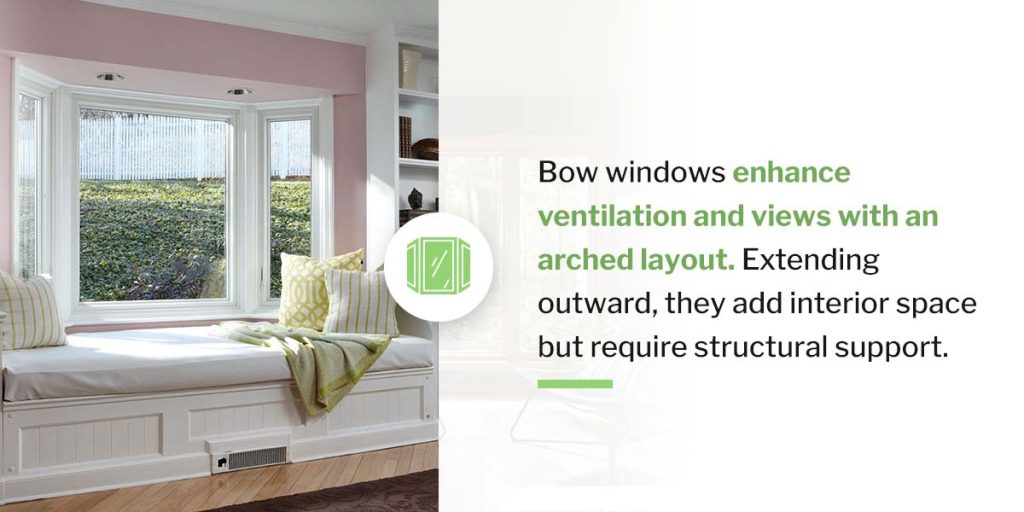
Bow windows have three or more windows in an arch layout with a central, nonoperable picture window. Like their bay counterparts, bow windows extend outward from the wall, giving you additional interior space.
Both window styles illuminate your home and provide a seamless connection between your indoor and outdoor spaces. However, they require a large opening and sufficient structural support because they carry a lot of weight.
Choosing the right type of window is just one factor in maintaining good ventilation. Optimal airflow also depends on where you place it.
Cross-ventilation is an effective strategy for creating a natural breeze throughout your home. The idea is simple – by positioning windows on opposite or adjacent walls, you give air a clear pathway to move through a room, replacing stale air with fresh outdoor air.
To get the best results, keep these practical tips in mind.
Take note of the direction breezes typically come from in your area and place windows where they can most effectively capture that airflow.
Interior doors, hallways and archways should stay open so air can move freely between rooms without getting trapped.
Combining different types of windows is an effective way of letting more fresh air into your home. For instance, casement windows catch side breezes, while double-hung windows allow for vertical airflow. Using both can help ventilate different parts of your home more effectively.
If your home has two or more floors, make sure each level has operable windows or doors. When hot air rises, you can leave windows on the upper floors open to keep your home comfortable, especially during the warmer months.
For passive ventilation to be truly effective, you should ventilate your house for at least 15 minutes five times each week.
Warm air naturally rises, so combining lower windows with higher openings will help push hot air out while drawing cooler air in from below.
Fresh airflow does far more than keep your living spaces comfortable. Here are a few key benefits of maintaining good airflow throughout your home:
By choosing the right window styles, you can turn passive airflow into an active cooling system, making your home more comfortable and energy-efficient without extra mechanical help.
Every window from Renewal by Andersen is custom-made to your home’s precise specifications and is available in several different styles. Call us or reach out online to schedule your free consultation.